
Researchers at EPFL use neural networks to study proprioception, the sense the brain uses to “know” the body’s movement and position.
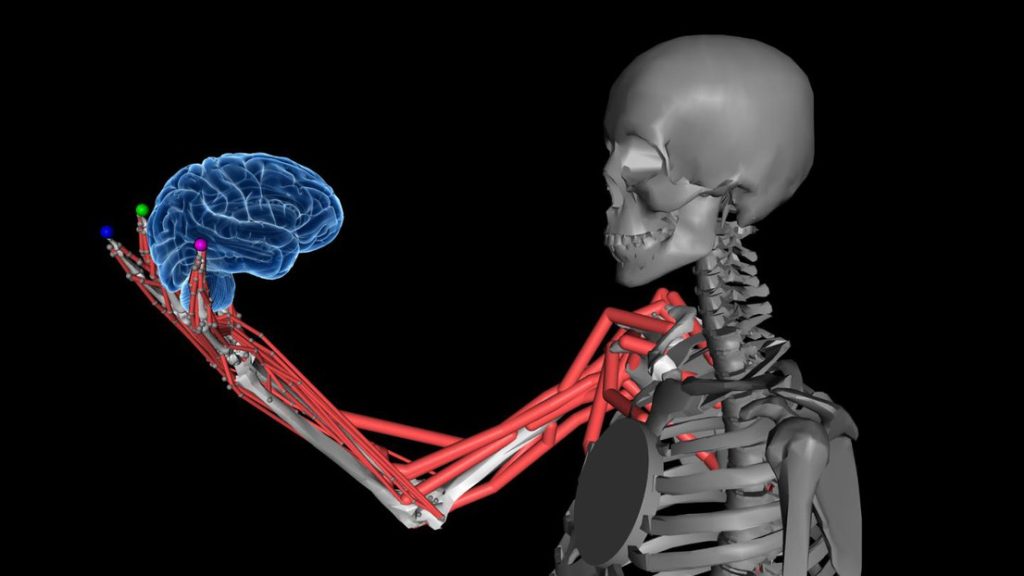
How does your brain know the position and movement of your different body parts? The sense is known as proprioception, and it is something like a “sixth sense”, allowing us to move freely without constantly watching our limbs.
Proprioception involves a complex network of sensors embedded in our muscles that relay information about limb position and movement back to our brain. However, little is known about how the brain puts together the different signals it receives from muscles.
A new study led by Alexander Mathis at EPFL now sheds light on the question by exploring how our brains create a cohesive sense of body position and movement. Published in Cell, the study was carried out by PhD students Alessandro Marin Vargas, Axel Bisi, and Alberto Chiappa, with experimental data from Chris Versteeg and Lee Miller at Northwestern University.
“It is widely believed that sensory systems should exploit the statistics of the world and this theory could explain many properties of the visual and auditory system,” says Mathis. “To generalize this theory to proprioception, we used musculoskeletal simulators to compute the statistics of the distributed sensors.”
The researchers used this musculoskeletal modeling to generate muscle spindle signals in the upper limb to generate a collection of “large-scale, naturalistic movement repertoire”. They then used this repertoire to train thousands of “task-driven” neural network models on sixteen computational tasks, each of which reflects a scientific hypothesis about the computations carried out by the proprioceptive pathway, which includes parts of the brainstem and somatosensory cortex.
The approach allowed the team to comprehensively analyse how different neural network architectures and computational tasks influence the development of “brain-like” representations of proprioceptive information. They found that neural network models trained on tasks that predict limb position and velocity were most effective, suggesting that our brains prioritize integrating the distributed muscle spindle input to understand body movement and position.
The research highlights the potential of task-driven modeling in neuroscience. Unlike traditional methods that focus on predicting neural activity directly, task-driven models can offer insights into the underlying computational principles of sensory processing.
The research also paves the way for new experimental avenues in neuroscience, since a better understanding of proprioceptive processing could lead to significant advancements in neuroprosthetics, with more natural and intuitive control of artificial limbs.
Funding
Swiss National Science Foundation (SNSF)
EPFL
Swiss Government Excellence Scholarship
References
Alessandro Marin Vargas, Axel Bisi, Alberto Chiappa, Chris Versteeg, Lee Miller, Alexander Mathis. Task-driven neural network models predict neural dynamics of proprioception. Cell 21 March 2024. DOI: 10.1016/j.cell.2024.02.036.
Author: Nik Papageorgiou
Source: EPFL