
Deepfake and You: Raising global awareness of deepfakes

Published

During its Presidency of the United Nations Security Council in October, the Swiss Confederation and EPFL, in collaboration with the International Committee of the Red Cross (ICRC), are presenting Deepfake and You, an exhibition which will run at the UN Headquarters from 15 to 25 October.

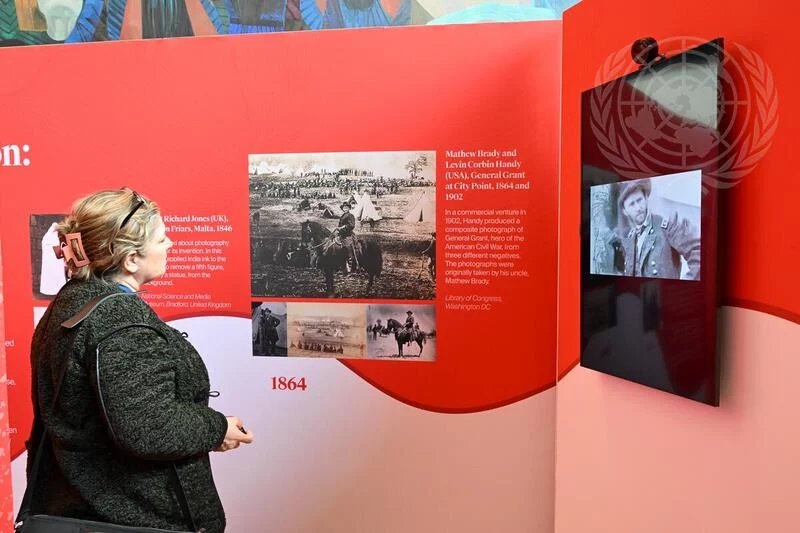
Deepfake and You is a real-time multimedia experience designed to raise awareness of the real-life social, political, and humanitarian consequences of manipulated information. This immersive project, for diplomats and the UN community in New York, is based on a technological solution developed by EPFL that revolves around an interactive experience. During the experience, participants will face their likeness being used to create a deepfake in a scenario developed under the supervision of the ICRC. The experience consists of a walk-through, maze-style installation, with screens and information on the walls.
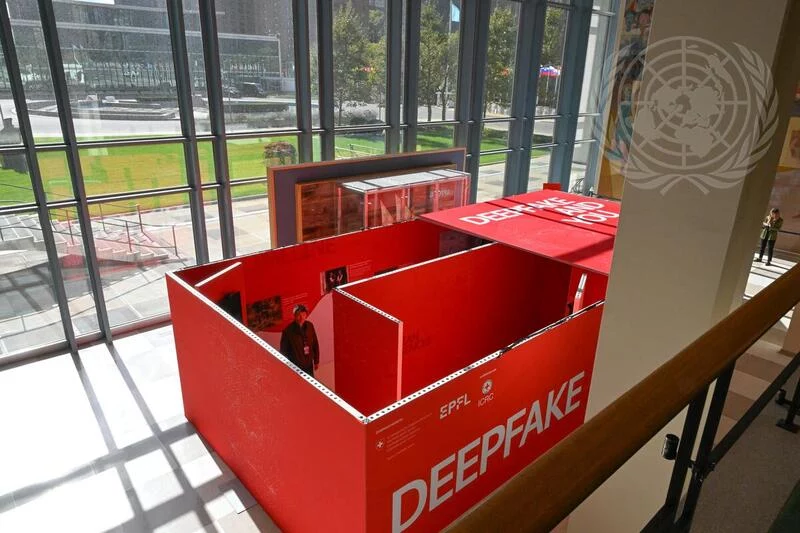
Building sustainable peace and protecting civilians in armed conflicts are priorities for Switzerland as an elected member of the UN Security Council. To achieve these objectives, it is crucial to take action against misinformation, disinformation and hate speech. This exhibition aims to raise awareness about these risks, with a focus on deepfake technology.

“Today’s exhibition serves both as a warning and a call to action”, declared Ambassador Pascale Baeriswyl, Permanent Representative of Switzerland to the UN at the opening on Monday. “It is designed to open our eyes to the ease with which truth and facts can be distorted, but also to show that solutions are within our reach. There are many ways to counter the spread and impact of deepfakes and disinformation: raising awareness, promoting accurate facts and developing algorithms which can detect and watermark deepfakes are only some among them. To be effective, these responses must be rooted in law and supported by strong ethical frameworks and international cooperation.”

At EPFL, a number of technical solutions are being developed to combat deepfakes. Peter Grönquist, researcher in the Image and Visual Representation Lab (IVRL) and technical director of the exhibition, won two international challenges on deepfake detection and hate-meme detection. The Lab, led by Prof. Sabine Süsstrunk focuses on the capture, analysis, and reproduction of color images and is active in deepfake detection. The computer science professor explains: “It’s a game of cat and mouse. The techniques for creating fake content evolve; the means of detecting them adapt, which triggers new ways of going under the radar, and the cycle repeats itself ad infinitum”. The institution is also exploring issues relating to digital trust and is counting on two centers for this: The Center for Digital Trust and the AI Center.
The International Committee of the Red Cross (ICRC) is a neutral, impartial and independent organization with an exclusively humanitarian mandate that stems from the Geneva Conventions of 1949. It helps people around the world affected by armed conflict and other violence, doing everything it can to protect their lives and dignity and to relieve their suffering, often alongside its Red Cross and Red Crescent partners.

More information: https://www.aplusforpeace.ch/are-you-really-who-you-think-you-are-deepfakes-exhibition-opens-un-headquarters
Share

You might be also interested in

EPFL researchers create an AI model that thinks like we do

An EPFL team has created a new Large Language Model that is structured similarly to a human brain, allowing users more control and moving away from “black box” AI.

When a standard Large Language Model (LLM) is confronted with a problem, it tries to solve it by matching it to similar information it has seen before, and then give an answer based on those past patterns. But how it decides which information to use and what value it gives to different pieces of information can be somewhat inscrutable from the outside.

The LLM MiCRo (Mixture of Cognitive Reasoners) is architecturally divided into four specialized areas that act like different parts of the human brain, allowing users to have more control over how it approaches a question, and to better understand how it comes to its answers. The model, which was presented at the International Conference on Learning Representations, comes from the NLP Lab, part of the School of Computer and Communication Sciences (IC), and the NeuroAI Lab, part of IC and the School of Life Sciences at EPFL.

The four experts

To create MiCRo, researchers identified four regions of the brains specializing in different functions, which they call ‘experts’: language, logic, social reasoning, and world knowledge.

“The brain is organized into specialized regions, each tuned to handle a specific function. So far, we don’t see this division of labor as clearly in current language models,” says Badr AlKhamissi, a PhD candidate leading this research. “We picked four brain regions that neuroscientists know well and gave the model its own specialized modules, each one trained to be analogous to one of those brain regions.”

An LLM usually functions as a stack of layers that a problem or question can be processed through. In the case of MiCRo, each layer is divided into the four different experts. You give a sentence to the model starting at layer one, for example “The cat is asleep”. Then within this layer, the router can choose one expert for the first word “the”, but a different epxert for second word “cat” and so on, making it modular and highly adaptable.

“Each word of a sentence can go to different experts,” AlKhamissi explains. “So one sentence can actually be processed by multiple experts at each layer.”

Consider a prompt like: “Emma wants to split a CHF 60 dinner bill among three friends, but she knows that Jake lost his job last week and is too proud to say he’s struggling.” A purely mathematical module handles the arithmetic: CHF 60 divided by three is CHF 20 each. But the social reasoning module picks up on something subtler: Emma’s awareness of Jake’s situation, his unspoken pride, and the implicit suggestion that she might quietly cover his share. Both kinds of reasoning are needed to fully understand what’s going on, and in MiCRo, each aspect of the prompt is routed to the expert best equipped to handle it.

“When we see how the model works, we can see that it routes the words that relate to the social aspects to the social expert, and when it does the mathematical part, it routes those numbers to the logic expert.”

This separation makes it easier to see how the model is ‘thinking’ and why it makes certain decisions. It also means decisions can be steered – for example, you can decide to increase the impact of the social expert, or suppress the logic expert, depending on what kind of model you want to use in a certain situation.

“In traditional LLMs, you can do this via prompting by telling the model to make the output more social or make it more related to emotions,” AlKhamissi says. “But here, this is done by intervening in the architecture itself without doing any prompting.”

“A virtuous circle”

To create MiCRo, the EPFL team worked with Greta Tuckute, a neuroscientist from Harvard and MIT, to understand which parts of the human brain are activated by different problems, and then applied that learning to the model.

To identify the region analogous to the ‘logic’ expert in the brain, neuroscientists give humans demanding tasks, such as hard mathematical equations, and less demanding tasks, like easy mathematical equations, and then recorded their brain activity to find which brain regions are the most active for the demanding tasks versus non-demanding tasks. AlKhamissi’s team then did the same for the model, giving it demanding mathematical equations to see which experts would be most activated.

“The cool thing is we just used exactly what they do in neuroscience, but in the model. And the model was able to identify those experts on its own.”

While neuroscience informs the model, the model also informs the understanding of the brain, potentially allowing neuroscientists to discover the contributions of different areas for a given problem or question; for example that a certain sentence activates the language areas 20%, the mathematical areas 50%, and the social reasoning areas 40%.

“For my PhD work, I have been interested in this virtuous circle between neuroscience and AI. In one direction, we use findings and insights from neuroscience about the brain and integrate them into language models,” AlKhamissi says, “and now, with models like MiCRo, we can explore the other direction and ask how we can use AI models to help us understand the brain in a better way.”

Author: Stephanie Parker
Source: EPFL

Smarter waste sorting with AI

EPFL startup WasteFlow has developed an AI-powered copilot that identifies and measures waste streams, helping sorting facilities work more efficiently. Support from several EPFL entrepreneurship programs helped the company accelerate the development of its technology.

(more…)

EPFL launches the world’s first fully open medical LLMs

MeditronFO is the first fully open framework for building medical large language models, to make AI in healthcare more transparent and accountable.

(more…)