
Studying collective bee behavior thanks to robotics

Published

EPFL researchers are developing robotic beehive frames that help locate honey stores inside of beehives over time, without relying on cameras. The aim is to develop new observation tools to study honeybee behavior that better fit the bees’ natural way to occupy space compared to current methods.
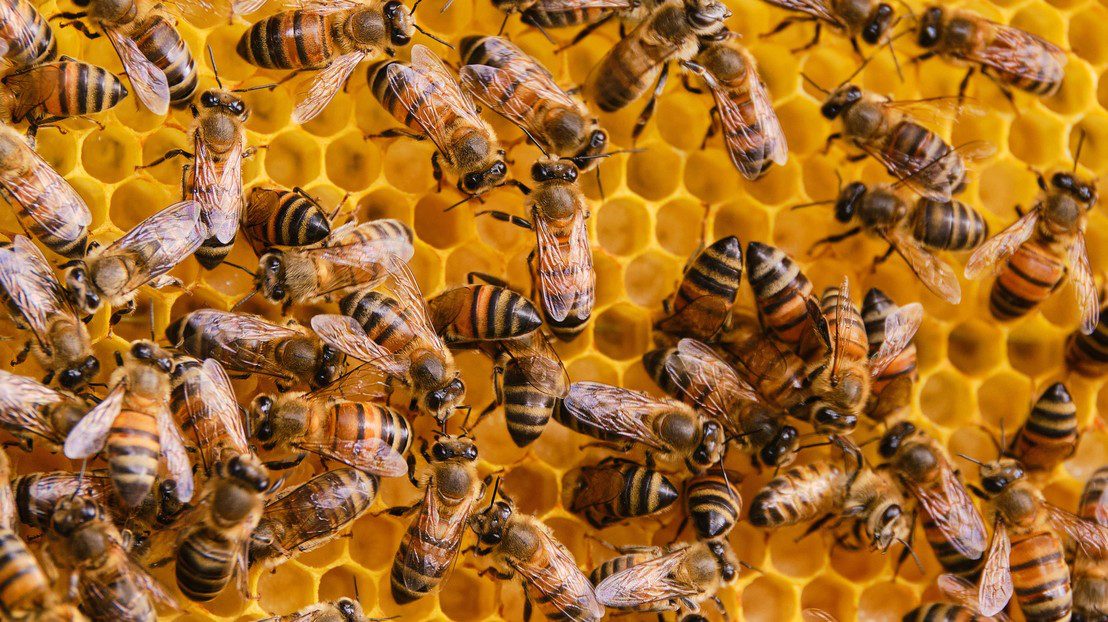
Cyril Monette is fascinated by collective behavior. Having studied how insects like cockroaches make collective decisions, the third year doctoral student in the EPFL’s Mobots Laboratory is now turning his attention towards the very useful, and much less repulsive insect: the honeybee. And he’s doing so with the help of robotics.

The bees inside of a hive naturally cluster into a volume the shape of a ball, at the intersection of the multiple frames of honeycomb inside of the hive. This ball-shaped configuration is likely optimal for the bees, yet observation hives developed by the scientific community study only one or two isolated frames at a time, forcing bees to occupy a flat disk instead.

“The isolated observation hive was built that way to allow for automated observation thanks to cameras or direct observation,” explains Monette who would like to offer a way to study bee behavior in relation to honey stores but in an environment that respects their instincts for clustering in space. “Unless we provide an environment that allows the bees to behave naturally, the observations yielded can only approximate how intact and strong colonies behave.”

Using the thermal properties of honey

To do away with cameras altogether, researchers from Mobots have developed a thermal robotic beehive frame upon which bees can build honeycomb. The robotic frame consists of 64 temperature sensors that can measure the temperature across 10 distinct regions that can be heated up separately, and since the bees build honeycomb on both sides of the frame, that corresponds to 20 honeycomb patches per frame where bees can potentially store honey. The idea is to first locate where the honey stores are and evaluate the amount of honey present in those 10 regions over time, and then to study bee behavior in relation to that.

“We’re interested in studying the relation between bee movement, their lifecycles and correlations with honey location within the hive over time. Our first challenge has been to accurately measure the amount of honey per region, in the absence of living bees, which we successfully achieved thanks to the thermal properties of honey,” explains Monette.

Because of honey’s particular thermal properties, it heats up and cools down differently compared to empty honeycomb. By sending a pulse of heat at increments of either +1, +3 or +5 degrees Celsius, the researchers are able to characterize how a region of honeycomb full of honey reacts thermally and therefore deduce the amount of honey per region. Specifically, the volume of honey is modeled according to the heating and cooling times combined with a measure of heating dynamics. These robotic frames can be combined in a hive to map the entirety of a colony’s honey stocks.

Other ecological studies

“By combining ethology and robotics we can make unprecedent observations of bees in nearly fully natural conditions, revealing behaviors never observed with this precision. This allows us to challenge and improve existing hypotheses on honeybee behavior and at the same time learn techniques that can help us to protect bees,” says Francesco Mondada who leads the Mobots Laboratory. “Moreover, combining these elements with our expertise in education allows us to share these observations to a broader audience – sparking curiosity about these fascinating, lesser-known behaviors that showcase the complexity of social insects’ life.”

Monette and colleagues are currently conducting experiments with their robotic observation hive to study bee behavior, testing various hypotheses in situ. “I’m intrigued by bee ethology, like the way the ball of bees expresses circadian rhythms by expanding and contracting throughout the day,” explains Monette. “With our robotic observation hive, I’m hoping to map honey resources and colony demographics over time, observe how the bee ball moves throughout the winter, and provide a framework for other ecological studies such as studying the impact of heatwaves on colonies.”

References
Conference paper: https://ieeexplore.ieee.org/abstract/document/10843927

Author: Hillary Sanctuary
Source: EPFL

Share

You might be also interested in

Nine ERC Advanced Grants awarded to EPFLresearchers

The European Research Council (ERC) awarded nine “ERC Advanced Grants” to EPFL researchers. This prestigious funding scheme gives senior researchers the opportunity to pursue ambitious, curiosity-driven projects that could lead to major scientific breakthroughs.

(more…)

EPFL researchers create an AI model that thinks like we do

An EPFL team has created a new Large Language Model that is structured similarly to a human brain, allowing users more control and moving away from “black box” AI.

When a standard Large Language Model (LLM) is confronted with a problem, it tries to solve it by matching it to similar information it has seen before, and then give an answer based on those past patterns. But how it decides which information to use and what value it gives to different pieces of information can be somewhat inscrutable from the outside.

The LLM MiCRo (Mixture of Cognitive Reasoners) is architecturally divided into four specialized areas that act like different parts of the human brain, allowing users to have more control over how it approaches a question, and to better understand how it comes to its answers. The model, which was presented at the International Conference on Learning Representations, comes from the NLP Lab, part of the School of Computer and Communication Sciences (IC), and the NeuroAI Lab, part of IC and the School of Life Sciences at EPFL.

The four experts

To create MiCRo, researchers identified four regions of the brains specializing in different functions, which they call ‘experts’: language, logic, social reasoning, and world knowledge.

“The brain is organized into specialized regions, each tuned to handle a specific function. So far, we don’t see this division of labor as clearly in current language models,” says Badr AlKhamissi, a PhD candidate leading this research. “We picked four brain regions that neuroscientists know well and gave the model its own specialized modules, each one trained to be analogous to one of those brain regions.”

An LLM usually functions as a stack of layers that a problem or question can be processed through. In the case of MiCRo, each layer is divided into the four different experts. You give a sentence to the model starting at layer one, for example “The cat is asleep”. Then within this layer, the router can choose one expert for the first word “the”, but a different epxert for second word “cat” and so on, making it modular and highly adaptable.

“Each word of a sentence can go to different experts,” AlKhamissi explains. “So one sentence can actually be processed by multiple experts at each layer.”

Consider a prompt like: “Emma wants to split a CHF 60 dinner bill among three friends, but she knows that Jake lost his job last week and is too proud to say he’s struggling.” A purely mathematical module handles the arithmetic: CHF 60 divided by three is CHF 20 each. But the social reasoning module picks up on something subtler: Emma’s awareness of Jake’s situation, his unspoken pride, and the implicit suggestion that she might quietly cover his share. Both kinds of reasoning are needed to fully understand what’s going on, and in MiCRo, each aspect of the prompt is routed to the expert best equipped to handle it.

“When we see how the model works, we can see that it routes the words that relate to the social aspects to the social expert, and when it does the mathematical part, it routes those numbers to the logic expert.”

This separation makes it easier to see how the model is ‘thinking’ and why it makes certain decisions. It also means decisions can be steered – for example, you can decide to increase the impact of the social expert, or suppress the logic expert, depending on what kind of model you want to use in a certain situation.

“In traditional LLMs, you can do this via prompting by telling the model to make the output more social or make it more related to emotions,” AlKhamissi says. “But here, this is done by intervening in the architecture itself without doing any prompting.”

“A virtuous circle”

To create MiCRo, the EPFL team worked with Greta Tuckute, a neuroscientist from Harvard and MIT, to understand which parts of the human brain are activated by different problems, and then applied that learning to the model.

To identify the region analogous to the ‘logic’ expert in the brain, neuroscientists give humans demanding tasks, such as hard mathematical equations, and less demanding tasks, like easy mathematical equations, and then recorded their brain activity to find which brain regions are the most active for the demanding tasks versus non-demanding tasks. AlKhamissi’s team then did the same for the model, giving it demanding mathematical equations to see which experts would be most activated.

“The cool thing is we just used exactly what they do in neuroscience, but in the model. And the model was able to identify those experts on its own.”

While neuroscience informs the model, the model also informs the understanding of the brain, potentially allowing neuroscientists to discover the contributions of different areas for a given problem or question; for example that a certain sentence activates the language areas 20%, the mathematical areas 50%, and the social reasoning areas 40%.

“For my PhD work, I have been interested in this virtuous circle between neuroscience and AI. In one direction, we use findings and insights from neuroscience about the brain and integrate them into language models,” AlKhamissi says, “and now, with models like MiCRo, we can explore the other direction and ask how we can use AI models to help us understand the brain in a better way.”

Author: Stephanie Parker
Source: EPFL

Smarter waste sorting with AI

EPFL startup WasteFlow has developed an AI-powered copilot that identifies and measures waste streams, helping sorting facilities work more efficiently. Support from several EPFL entrepreneurship programs helped the company accelerate the development of its technology.

(more…)