
A new national initiative aims to develop a secure, Swiss-hosted infrastructure to enable AI-enhanced precision oncology across Switzerland while ensuring sensitive and personal health data remains protected.

According to the Global Cancer Observatory, cancer remains one of the country’s most pressing public health challenges, with nearly 58,000 new cases and close to 20,000 deaths recorded in 2022. Achieving fully personalized care remains challenging due to fragmented data and limited integration across institutions. A closer coordination across the national healthcare network will result in more effective and equitable treatments for patients.
NAIPO (National AI Initiative for Precision Oncology) responds to this need with an integrated, AI-powered precision oncology platform to transform cancer care delivery. By applying advanced AI models at every stage of the patient journey, it aims to optimize diagnostics, personalize treatments, and support data-driven clinical decision-making. “Building on lessons from previous efforts in precision oncology in Switzerland, our initiative targets the development of novel, clinically informed AI tools by seamlessly integrating a common data platform, continuously adapting robust models, and designing effective clinical interfaces and patient apps.” says Dorina Thanou, lead of the initiative at the EPFL AI Center.
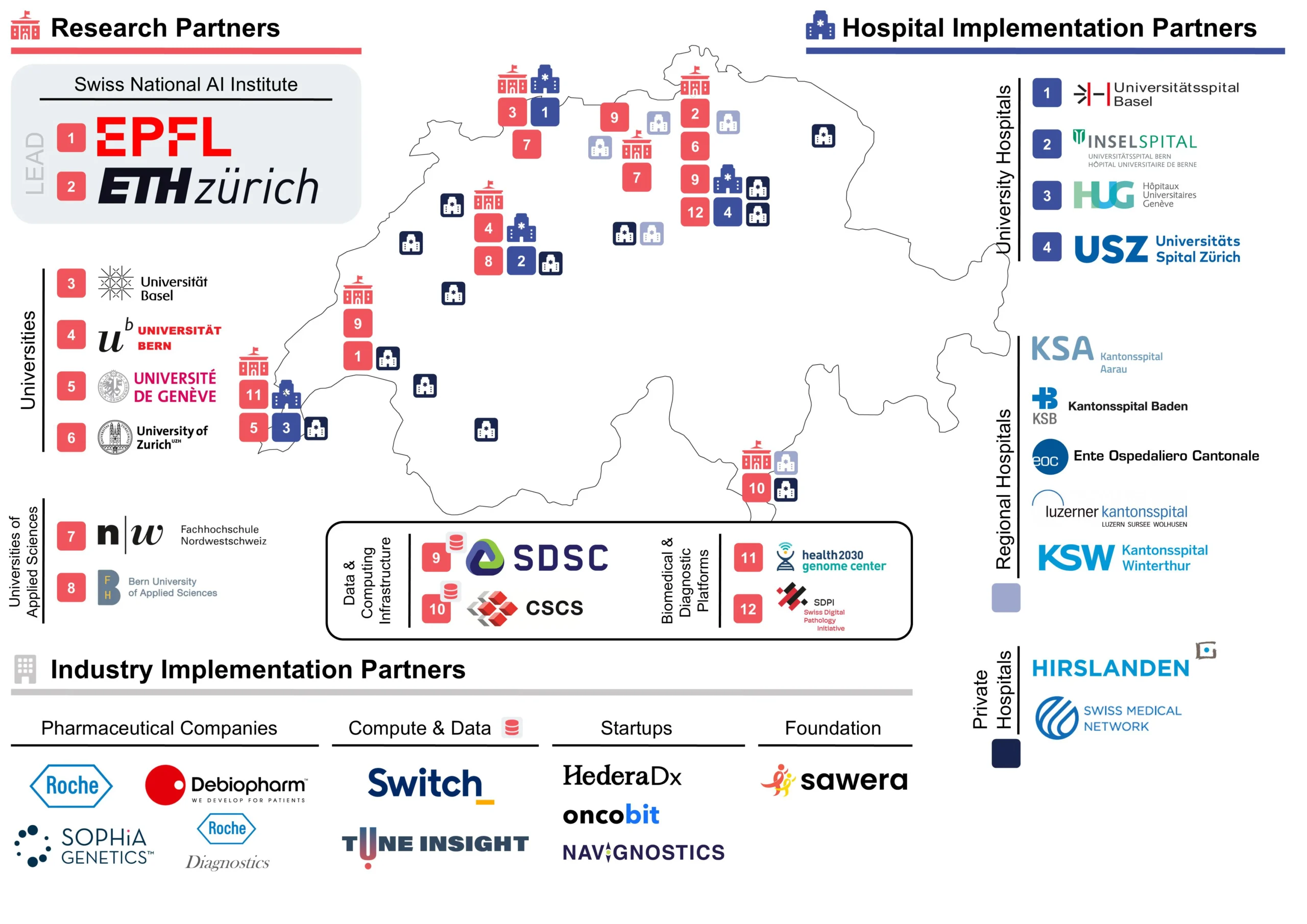
Selected as a Flagship Initiative by Innosuisse, the Swiss Innovation Agency, NAIPO will unfold over four years under the leadership of the EPFL AI Center and ETH AI Center, uniting a large transdisciplinary team from a wide array of institutions including the Swiss Data Science Center (SDSC), the Swiss National Supercomputing Centre (CSCS), the Universities of Applied Sciences and Arts of Northwestern Switzerland, the Bern University of Applied Sciences, the Universities and University Hospitals of Basel, Bern, Geneva, and Zurich, Debiopharm, Roche, SOPHIA GENETICS, Switch, Tune Insight, as well as the regional hospitals of Aarau, Baden, Ticino, Luzern and Winterthur and the private clinics of Hirslanden and Swiss Medical Network. With an expected total cost of CHF 18.9 million, the project will receive approximately CHF 8.25 million in public funding from Innosuisse with the remaining amount coming from the implementation partners.
Transforming cancer research
NAIPO pioneers new AI approaches in cancer research and care, from clinical decision-support agents and large language models for records mining, to foundation models for treatment response prediction and privacy-preserving approaches. “Combined with high-throughput experimental models and patient avatars, these technologies will allow us to capture and model each patient’s uniqueness.The program will redefine AI’s role in medicine and strengthen Switzerland’s position as a leader in medical AI innovation” said Elisa Oricchio, director of the Swiss Institute of Experimental Cancer Research (ISREC) at EPFL
“Tailoring predictions and recommendations to individual patients is one of the most exciting aspects of NAIPO,” said Charlotte Bunne, professor at EPFL working on model development. “Our models will continuously learn from curated biomedical literature, as well as from individual biological and clinical data to identify potential new targets, biomarkers, and investigational drugs. Novel AI-driven insights will be integrated with clinically validated models and translated into decision-support systems.” Placing patients’ specific needs at the center of the initiative, dedicated solutions will be developed, such as a mobile app, to enhance communication and ensure patients remain actively informed and engaged throughout their care.
Deployment and long-term vision
The program’s roadmap foresees clinical pilots at university and cantonal hospitals and private clinics, leading to an initial rollout at participating hospitals nationwide within four years. In addition to advancing cancer care, the infrastructure is intended to serve as a model for future applications in other disease domains.
“This initiative marks a transition toward a proactive model for precision oncology,” said Olivier Michielin, Head of Precision Oncology at Geneva University Hospitals (HUG) and Clinical Co-Coordinator of the project. “It reflects a commitment to ensuring that all patients, regardless of where they are treated within this network, benefit from the latest advances in AI-supported medicine.”
Secure, privacy-conscious collaboration is central to the initiative. Using modern data governance, the infrastructure will enable collective intelligence without centralizing sensitive health data. “We’re creating a secure and federated system that allows collaboration across institutions without compromising privacy,” said Nora Toussaint, Lead Health & Biomedical at the Swiss Data Science Center (SDSC). “Trust and transparency will be built into the design.”
“NAIPO is exactly what clinical oncology needs today. We are able to produce much more data than a couple of years ago, but we often don’t know how to integrate this in actual patient care. NAIPO is instrumental to close this gap.” Says Andreas Wicki, oncology professor at the University of Zurich and Clinical Co-Coordinator of the project.
NAIPO’s long-term vision includes reducing disparities in access, accelerating the discovery of new biomarkers and treatments, and supporting sustainable innovation across the Swiss healthcare system. Milestones and key results will be shared as the project progresses.

Author: Mélissa Anchisi
Source: EPFL