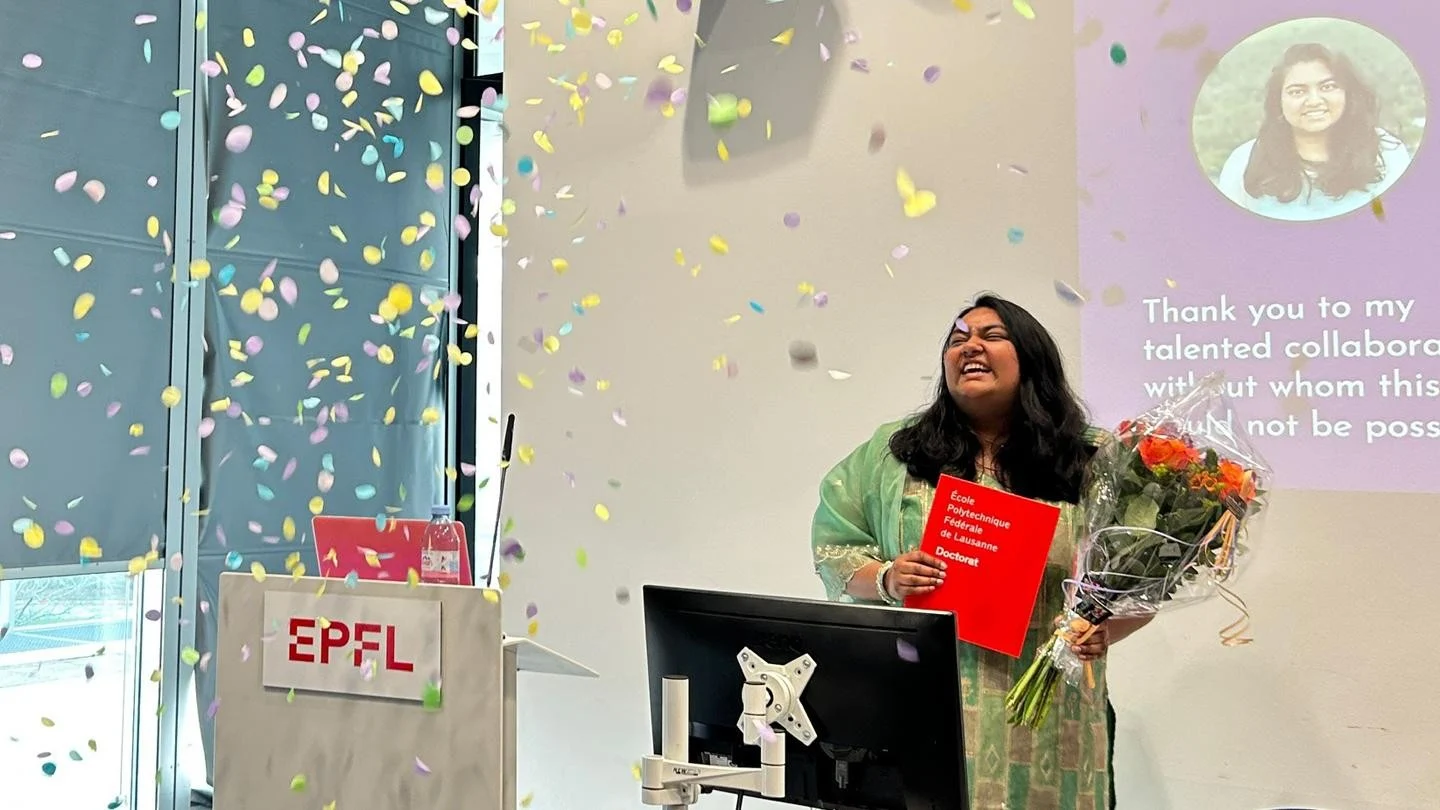
Vinitra Swamy, the first graduate of the Machine Learning for Education Laboratory (ML4ED), has been awarded the Patrick Denantes Memorial Prize for 2025. This award is given each year to a doctoral student in the School of Computer and Communication Sciences for the best thesis.
When Vinitra Swamy was working as an AI engineer at Microsoft AI in the United States, she noticed something unexpected – large companies were choosing to use less performant AI models even though better ones were available.
“We realized that they wanted to know why a certain decision was made, and that was more important than being more accurate,” Swamy explains. “It was surprising to me. I knew that there should be a way to have the advantages of modern neural network architectures without sacrificing interpretability, especially in these human-centric environments.”
This realization led her to EPFL and the newly-created ML4ED group of Tanja Käser, where she completed her PhD thesis A Human-Centric Approach to Explainable AI for Personalized Education.
Swamy started her research by looking across millions of student interactions in online courses. The goal was to provide tailored learning interventions for online students who were struggling with a course, setting them back on the right learning track even for a new course or one with a limited budget for interventions. Swamy focused on explaining these AI models in such a way that would facilitate effective interventions.
There were a few popular explainer models that AI engineers were using in human-centric fields. The engineers would first train the model, then use one of these explainers afterwards to understand why the model had made its prediction. Swamy found that, especially in the case of education, the five most popular explainers systematically disagreed with one another.
“Imagine you have a student going through a class, a model says this student is on track to fail, and each explainer gives a completely different reason for the prediction. The result was shocking,” Swamy says. “It was a turning point in my PhD, where we realized these explainers were not the full answer to the interpretability problem.”
This convinced Swamy of the importance of designing neural network architectures that incorporate interpretability in the design itself, where the explanation is used directly in the prediction. This led her to designing new AI architectures MultiModN and InterpretCC, as well as a LLM explanation pipeline iLLuminaTE, all of which incorporate real-time interpretation and understandability through modular and mixture-of-experts approaches.
“We have proven that there are new, interpretable neural network architectures that are not only as performant as their counterparts, but provide real-time explanations with consistency, actionability, and understandability,” Swamy says.
Her research was also unique because of her emphasis on user studies, including a teacher evaluation of interpretable-by-design neural network architectures, measuring educator perceptions about the inconsistency of explainable AI, and conducting large-scale student evaluations.
Her team’s model MultiModN is now being used for clinical trials of pneumonia and tuberculosis diagnosis in low-resource settings across Africa due to its strengths in interpretability and robustness in the face of missing data. She also helped design student AI feedback studies with hundreds of students across EPFL classrooms, along with a global physician evaluation for the open medical language model Meditron.
“Tanja [Käser] puts a human emphasis at the center of everything we do at ML4ED. We are actually seeing how AI can be used on real and messy data, and we make sure to listen to the learners and teachers in co-design sessions before we run a large-scale study, which makes it much more likely that this research can be applied immediately.”
Along with being awarded the prestigious Patrick Denantes prize, Swamy’s thesis research was awarded the GResearch PhD Prize and formed the basis of her recent AI for education startup Scholé, co-founded with ML4ED graduate Paola Mejia-Domenzain. They are already collaborating with companies like Decathlon and Swisscom on providing personalized training for employees in AI and data science based on a modular agentic architecture. Swamy is now serving as teaching faculty for Harvard’s new set of AI intensive courses offered to learners around the world, in partnership with Scholé.
“I never imagined that this research could be in the hands of learners so soon after the PhD. I feel extremely grateful to my collaborators. It’s not something I take lightly,” Swamy says.
“It means a lot to me to win this award. I wouldn’t be here without my amazing advisors Tanja Käser and Martin Jaggi, my labmates and friends here in Switzerland who always supported me, and my loving family at home in California who inspired me every step of the way.”
Patrick Denantes was an IC doctoral student who passed away in a mountain accident in 2009. The annual prize in Patrick’s name honors his memory. The prize is awarded by a jury and presented to the laureate at the School’s end-of-year event. Financial sponsorship is provided by the Denantes family and the Nokia Research Center. The laureate receives a sum of CHF5,000.
Author: Stephanie Parker
Source: Computer and Communication Sciences | IC