
Maksym Andriushchenko, who received his PhD from the Theory of Machine Learning (TML) laboratory in 2024, received the ELLIS PhD Award, and Francesco D’Angelo, a current TML doctoral student was awarded a prestigious Google PhD Fellowship.
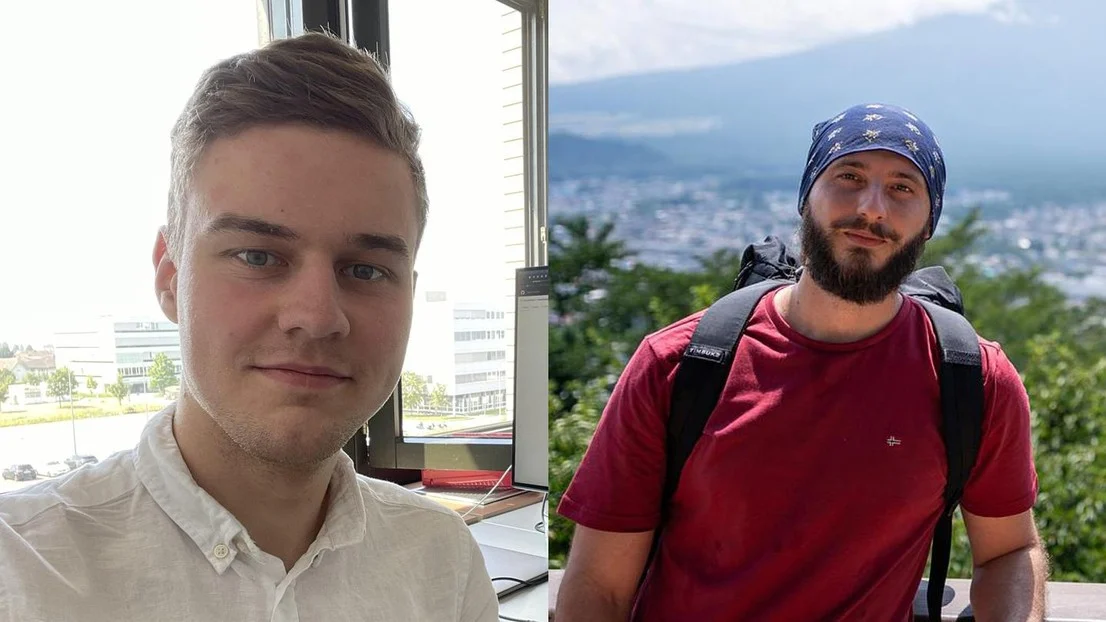
“These two awards are a great recognition for the lab and for EPFL’s strength in machine learning, and they highlight how important it is to ground today’s AI progress in theory,” says Nicolas Flammarion, professor and head of the TML laboratory.
“Maksym’s work on safety and adversarial robustness and Francesco’s work on interpretability address two central challenges for modern models: reliability and understanding. What I find especially exciting is that both projects take a rigorous theoretical approach while still delivering concrete outcomes that can inform how we build and deploy current systems.”
Maksym Andriushchenko
Andriushchenko was given the ELLIS PhD Award for his thesis “Understanding Generalization and Robustness in Modern Deep Learning” which was also awarded the Patrick Denantes Memorial Prize for the best thesis in the Computer Sciences department of EPFL and was supported by the Google and Open Phil AI PhD Fellowships.
His thesis looked at fundamental questions about why modern deep networks can be easily fooled yet still generalize well, by developing efficient adversarial training methods, identifying catastrophic overfitting, proposing query-efficient black-box attacks, and creating the RobustBench benchmark used for standardized robustness evaluation. He also showed how algorithms shape learned features and test performance, and provided rigorous evidence that many popular “sharpness” measures mostly reflect training settings rather than truly predicting how well models generalize.
“I am deeply honored to receive this prestigious award,” says Andriushchenko. “I’m incredibly grateful to my PhD and master’s advisors, Prof. Nicolas Flammarion and Prof. Matthias Hein, who taught me so much about machine learning and helped shape my research taste.”
Andriushchenko is currently a Principal Investigator at the ELLIS Institute Tübingen and the Max Planck Institute for Intelligent Systems, where he leads the AI Safety and Alignment group. He also serves as a chapter lead for the new edition of the International AI Safety Report and has previously collaborated on AI safety with leading organizations including OpenAI, Anthropic, the UK AI Safety Institute, the Center for AI Safety, and Gray Swan AI.
This is the second ELLIS award received by an EDIC student since 2019.
Francesco D’Angelo
D’Angelo is currently a PhD candidate in the TML laboratory working on interpretability in AI. His Google Fellowship will cover his salary for the next two years as well as other expenses, and provides him with a mentor from Google with whom he can discuss his research.
“The fellowship allows me to understand the research focus within a frontier company, helping me bridge the gap between theory and real-world challenges.” D’Angelo says.
Google says the Fellowships are awarded to “exceptional graduate students pioneering research in computer science and related fields, with the goal of supporting the next generation of scientists focused on critical foundational science.”
D’Angelo began his PhD at EPFL by investigating the fundamental dynamics of neural network training, specifically examining how weight decay, a key regularization technique, influences how models generalize to new data. As the field shifted toward large-scale Transformers, his focus evolved into mechanistic interpretability to uncover the internal functioning of these models.
He has since explored how models learn to selectively filter information and focus on relevant patterns, identifying the specific mechanisms that allow them to process complex sequences. Today, his research aims to reverse-engineer the computational circuits that enable in-context learning. By studying how Transformers handle synthetic tasks, he seeks to demonstrate that these models do not merely map patterns, but how their weights are organized to implement algorithms.
“You can really see attention layers organizing in these precise structures, and then you want to understand how they combine with each other and what they are implementing,” he says.
He is excited to continue his research at EPFL and is looking forward to possibly pursuing a postdoc after receiving his PhD.
Author: Stephanie Parker
Source: Computer and Communication Sciences | IC