
How to teach the same skill to different robots

Published

A new framework developed by EPFL researchers makes it possible to teach a skill to robots with different mechanical designs, allowing them to carry out the same task safely without rewriting code for each.
In today’s manufacturing environments, upgrading a robot fleet often means starting from scratch – not only replacing hardware, but also reprogramming tasks. Even when two robots are built to perform similar jobs, different joint arrangements or movement limits mean that a task programmed for one robot often can’t be used on another. Enabling skills to transfer directly between robots could make these systems more sustainable and cost-efficient.

To meet this challenge, researchers in the Learning Algorithms and Systems Laboratory (LASA) in EPFL’s School of Engineering have developed a new robotic control framework called Kinematic Intelligence. The method takes a human-demonstrated task, mathematically converts it into a general movement strategy, and then adapts it so that different robots can perform it based on their physical design. The research has been published in Science Robotics.

“This work addresses a long-standing challenge in robotics: how to transfer a learned skill across robots with different mechanical structures, while guaranteeing safe and predictable behavior,” says LASA head Aude Billard. “This approach could significantly reduce the time and expertise needed to deploy robots in real-world settings.”

Kinematic Intelligence for transferable robot learning

To build their framework, the researchers first took human-demonstrated object‑manipulation tasks – such as placing, pushing and throwing – and recorded them using motion-capture technology. Then, they mathematically converted these recorded tasks into general movement strategies. They also developed a systematic classification of the physical limits of different robot designs, including how far their joints can move and which positions they must avoid to remain stable. The framework then uses this classification to automatically tailor the general movement strategies to different robot bodies, ensuring they can carry out tasks safely within their mechanical limits.

Each robot interprets the same skill in its own way, but always within safe and feasible limits.”

LASA Phd student and co-first author Sthithpragya Gupta

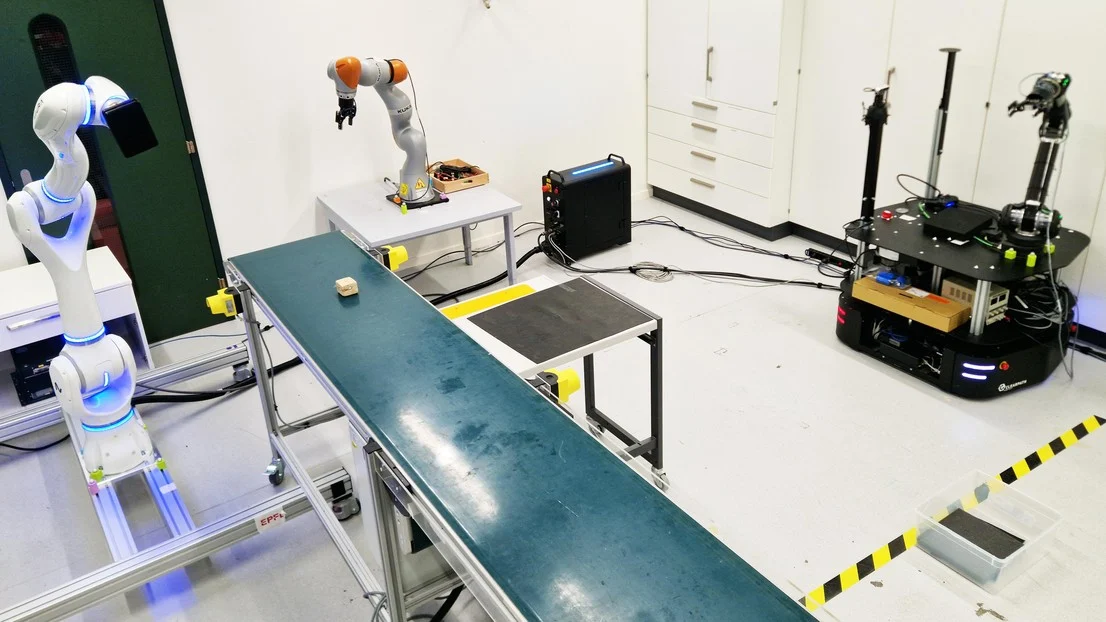
In an assembly line experiment, a human demonstrated a task by pushing a wooden block off a conveyor belt onto a workbench, placing it on a table, and finally throwing it into a basket. By using Kinematic Intelligence, three completely different commercial robots were able to reproduce this same sequence safely and reliably.

“Each robot handled different steps of the task, and the system performed successfully even when the step allocation was changed,” explains LASA PhD student and co-first author Sthithpragya Gupta. “Each robot interprets the same skill in its own way, but always within safe and feasible limits.”

Towards scalable and future-ready robotics

The researchers aim to extend the framework to settings such as human-robot collaboration and natural language-based interaction. For example, Kinematic Intelligence could allow a person to instruct a robot with simple commands at home, with no need for technical programming. The approach is also relevant for emerging robotic platforms, where rapid hardware evolution means that today’s machines may soon be replaced by newer versions. Enabling seamless transfer of skills across such platforms could play a key role in making them practical and scalable.

“Our goal is to remove the need for technical expertise while still ensuring safe and reliable operation,” summarizes LASA scientist and co-first author Durgesh Haribhau Salunkhe. “The user brings the idea and the desired behavior, and the robot should take care of the rest.”

References
Gupta S., Salunkhe D. H., Billard A. “Demonstrate once, execute on many: Kinematic intelligence for cross-robot skill transfer”. Science Robotics (2026). 10.1126/scirobotics.aea1995

Author: Celia Luterbacher
Source: EPFL

Share

You might be also interested in

EPFL researchers create an AI model that thinks like we do

An EPFL team has created a new Large Language Model that is structured similarly to a human brain, allowing users more control and moving away from “black box” AI.

When a standard Large Language Model (LLM) is confronted with a problem, it tries to solve it by matching it to similar information it has seen before, and then give an answer based on those past patterns. But how it decides which information to use and what value it gives to different pieces of information can be somewhat inscrutable from the outside.

The LLM MiCRo (Mixture of Cognitive Reasoners) is architecturally divided into four specialized areas that act like different parts of the human brain, allowing users to have more control over how it approaches a question, and to better understand how it comes to its answers. The model, which was presented at the International Conference on Learning Representations, comes from the NLP Lab, part of the School of Computer and Communication Sciences (IC), and the NeuroAI Lab, part of IC and the School of Life Sciences at EPFL.

The four experts

To create MiCRo, researchers identified four regions of the brains specializing in different functions, which they call ‘experts’: language, logic, social reasoning, and world knowledge.

“The brain is organized into specialized regions, each tuned to handle a specific function. So far, we don’t see this division of labor as clearly in current language models,” says Badr AlKhamissi, a PhD candidate leading this research. “We picked four brain regions that neuroscientists know well and gave the model its own specialized modules, each one trained to be analogous to one of those brain regions.”

An LLM usually functions as a stack of layers that a problem or question can be processed through. In the case of MiCRo, each layer is divided into the four different experts. You give a sentence to the model starting at layer one, for example “The cat is asleep”. Then within this layer, the router can choose one expert for the first word “the”, but a different epxert for second word “cat” and so on, making it modular and highly adaptable.

“Each word of a sentence can go to different experts,” AlKhamissi explains. “So one sentence can actually be processed by multiple experts at each layer.”

Consider a prompt like: “Emma wants to split a CHF 60 dinner bill among three friends, but she knows that Jake lost his job last week and is too proud to say he’s struggling.” A purely mathematical module handles the arithmetic: CHF 60 divided by three is CHF 20 each. But the social reasoning module picks up on something subtler: Emma’s awareness of Jake’s situation, his unspoken pride, and the implicit suggestion that she might quietly cover his share. Both kinds of reasoning are needed to fully understand what’s going on, and in MiCRo, each aspect of the prompt is routed to the expert best equipped to handle it.

“When we see how the model works, we can see that it routes the words that relate to the social aspects to the social expert, and when it does the mathematical part, it routes those numbers to the logic expert.”

This separation makes it easier to see how the model is ‘thinking’ and why it makes certain decisions. It also means decisions can be steered – for example, you can decide to increase the impact of the social expert, or suppress the logic expert, depending on what kind of model you want to use in a certain situation.

“In traditional LLMs, you can do this via prompting by telling the model to make the output more social or make it more related to emotions,” AlKhamissi says. “But here, this is done by intervening in the architecture itself without doing any prompting.”

“A virtuous circle”

To create MiCRo, the EPFL team worked with Greta Tuckute, a neuroscientist from Harvard and MIT, to understand which parts of the human brain are activated by different problems, and then applied that learning to the model.

To identify the region analogous to the ‘logic’ expert in the brain, neuroscientists give humans demanding tasks, such as hard mathematical equations, and less demanding tasks, like easy mathematical equations, and then recorded their brain activity to find which brain regions are the most active for the demanding tasks versus non-demanding tasks. AlKhamissi’s team then did the same for the model, giving it demanding mathematical equations to see which experts would be most activated.

“The cool thing is we just used exactly what they do in neuroscience, but in the model. And the model was able to identify those experts on its own.”

While neuroscience informs the model, the model also informs the understanding of the brain, potentially allowing neuroscientists to discover the contributions of different areas for a given problem or question; for example that a certain sentence activates the language areas 20%, the mathematical areas 50%, and the social reasoning areas 40%.

“For my PhD work, I have been interested in this virtuous circle between neuroscience and AI. In one direction, we use findings and insights from neuroscience about the brain and integrate them into language models,” AlKhamissi says, “and now, with models like MiCRo, we can explore the other direction and ask how we can use AI models to help us understand the brain in a better way.”

Author: Stephanie Parker
Source: EPFL

Smarter waste sorting with AI

EPFL startup WasteFlow has developed an AI-powered copilot that identifies and measures waste streams, helping sorting facilities work more efficiently. Support from several EPFL entrepreneurship programs helped the company accelerate the development of its technology.

(more…)

EPFL launches the world’s first fully open medical LLMs

MeditronFO is the first fully open framework for building medical large language models, to make AI in healthcare more transparent and accountable.

(more…)