
Mice actively seek better views to make visual decisions

Published

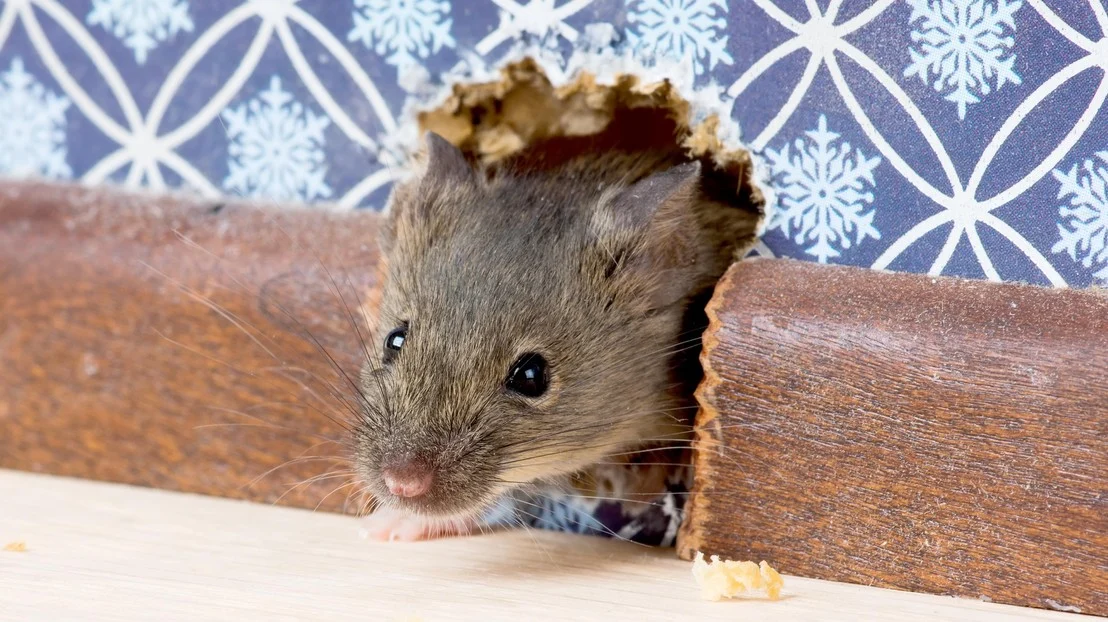
A study led by EPFL shows that when objects are difficult to see, mice don’t simply look harder. They move to find better viewpoints, adjusting their behavior according to how much visual information is available.
Animals don’t experience the world passively. A hawk tilts its head to track prey. A person leans forward to read a sign. Scientists call this “active sensing”: moving the body to gather better information.

A specific version of active sensing is infotaxis, which describes how animals move strategically to maximize the information they gain from their surroundings. Whether mice use this strategy has remained an open question, despite their central role in neuroscience research.

Mice have low visual acuity, roughly seven to eight times worse than humans. They also lack foveas, the small, specialized areas in the eye’s retina that allow us sharp, clear central vision, color perception, and fine detail.

Because of these apparent deficiencies, researchers have assumed that mice rely on smell, their whiskers, and hearing far more than sight. At the same time, we know that mice use vision for a range of tasks, from detecting predators and capturing prey to navigating spaces.

A team of scientists led by Mackenzie Weygandt Mathis, professor at the Bertarelli Foundation Chair of Integrative Neuroscience at EPFL, has now shown that mice do perform visual infotaxis. Using a custom-built virtual reality (VR) system, they show that mice move strategically to seek out more informative views of partially hidden objects, and that this behavior adjusts precisely to how much visual information is available.

The work is published in Current Biology.

Black and white teardrops

The researchers built a freely moving VR “arena” where a screen displayed a 3D scene rendered in real time from the mouse’s point of view. They tracked the animals’ positions and movements a 100 Hz overhead camera and DeepLabCut-Live, a marker-less tracking platform that Mathis’s group developed in 2020.

Mice were trained to identify the location of a target object, a white teardrop, from a distractor, a black teardrop, and indicated their choice by walking to the corresponding side of the arena.
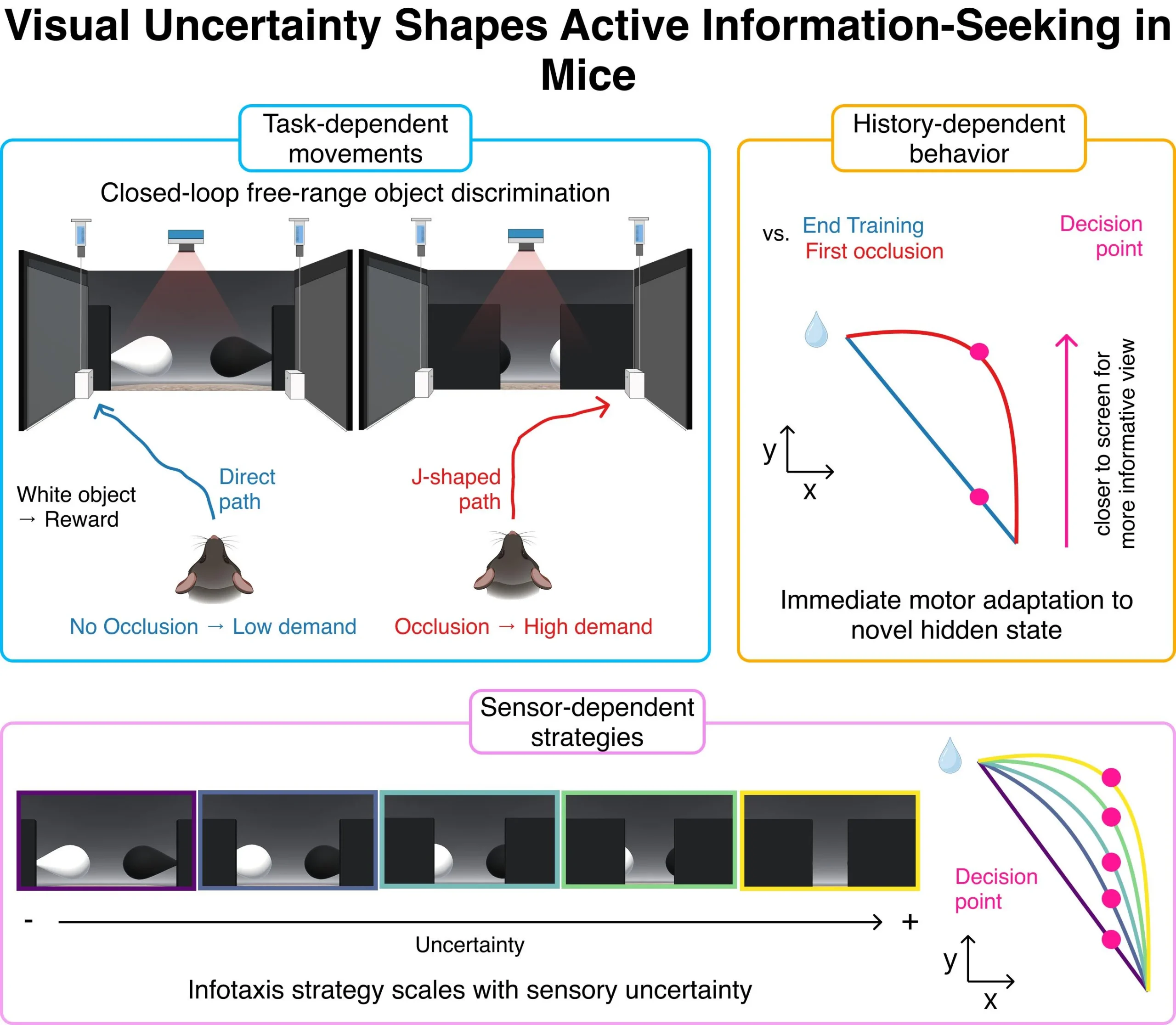
An illustration of the infotaxis experiment ©2026 EPFL

Then came the key manipulation: the screen would place virtual walls in front of both the target and distractor objects, leaving only a narrow central gap. In the most restricted condition of the first experiment, only 10% of each object was visible from the starting area. But as the mice walked closer to the screen, the viewing angle widened and more of the hidden objects came into view.

When the teardrops were mostly hidden, mice walked significantly closer to the screen before committing to a choice, slowed down during the approach, and took more winding paths. They sometimes reversed direction mid-trial when new visual evidence came in.

A fully open-source platform

The team tested five levels of occlusion and found that the mice’s infotaxic behavior scaled continuously. The less the target was visible, the closer the mice moved before making a choice. Mice that moved closer also tended to make more correct choices under the most difficult conditions, suggesting that the strategy helped them solve the task.

The mice showed this behavior immediately when they first encountered occluded objects, after they had already learned the task. This suggests that they drew on an internal understanding of the environment to meet a new visual challenge.

The work shows that even mice, despite their relatively poor vision, actively move to gather better visual information rather than simply react to what they see. The team has made the platform fully open source and proposes that it is well suited for future studies combining brain recordings with active visual behavior, helping researchers understand how seeing and moving are coordinated in the brain.

This experiment, conducted underconditions governed by Swiss animal welfare legislation, was approved by the relevant veterinary authorities.

Other contributors

  • Baylor College of Medicine
  • Stanford University
  • University of Oregon
  • Carnegie Mellon University
  • Rice University
  • Columbia Engineering School
  • Tübingen University

Funding

NIG Brain Initiative

References

Célia Benquet, Thomas Sainsbury, Léo Bruneau, Yang Lin, Chenchen Cai, Mariia Popova, Kayla Ponder, Lydia Ntanavara, Rachel Froebe, Zheng Tan, Paul Fahey, Katrin Franke, Luis M. Franco, Keaton Jones, Yizhou Chen, Reece Keller, Xaq Pitkow, Cristopher M. Niell, Andreas S. Tolias, Mackenzie Weygandt Mathis. Visual uncertainty and task demands shape active sensing strategies in mice. Current Biology 20 July 2026. DOI: 10.1016/j.cub.2026.06.011

Author: Nik Papageorgiou
Source: EPFL

Share

You might be also interested in

Nine ERC Advanced Grants awarded to EPFL researchers

The European Research Council (ERC) awarded nine “ERC Advanced Grants” to EPFL researchers. This prestigious funding scheme gives senior researchers the opportunity to pursue ambitious, curiosity-driven projects that could lead to major scientific breakthroughs.

(more…)

EPFL researchers create an AI model that thinks like we do

An EPFL team has created a new Large Language Model that is structured similarly to a human brain, allowing users more control and moving away from “black box” AI.

When a standard Large Language Model (LLM) is confronted with a problem, it tries to solve it by matching it to similar information it has seen before, and then give an answer based on those past patterns. But how it decides which information to use and what value it gives to different pieces of information can be somewhat inscrutable from the outside.

The LLM MiCRo (Mixture of Cognitive Reasoners) is architecturally divided into four specialized areas that act like different parts of the human brain, allowing users to have more control over how it approaches a question, and to better understand how it comes to its answers. The model, which was presented at the International Conference on Learning Representations, comes from the NLP Lab, part of the School of Computer and Communication Sciences (IC), and the NeuroAI Lab, part of IC and the School of Life Sciences at EPFL.

The four experts

To create MiCRo, researchers identified four regions of the brains specializing in different functions, which they call ‘experts’: language, logic, social reasoning, and world knowledge.

“The brain is organized into specialized regions, each tuned to handle a specific function. So far, we don’t see this division of labor as clearly in current language models,” says Badr AlKhamissi, a PhD candidate leading this research. “We picked four brain regions that neuroscientists know well and gave the model its own specialized modules, each one trained to be analogous to one of those brain regions.”

An LLM usually functions as a stack of layers that a problem or question can be processed through. In the case of MiCRo, each layer is divided into the four different experts. You give a sentence to the model starting at layer one, for example “The cat is asleep”. Then within this layer, the router can choose one expert for the first word “the”, but a different epxert for second word “cat” and so on, making it modular and highly adaptable.

“Each word of a sentence can go to different experts,” AlKhamissi explains. “So one sentence can actually be processed by multiple experts at each layer.”

Consider a prompt like: “Emma wants to split a CHF 60 dinner bill among three friends, but she knows that Jake lost his job last week and is too proud to say he’s struggling.” A purely mathematical module handles the arithmetic: CHF 60 divided by three is CHF 20 each. But the social reasoning module picks up on something subtler: Emma’s awareness of Jake’s situation, his unspoken pride, and the implicit suggestion that she might quietly cover his share. Both kinds of reasoning are needed to fully understand what’s going on, and in MiCRo, each aspect of the prompt is routed to the expert best equipped to handle it.

“When we see how the model works, we can see that it routes the words that relate to the social aspects to the social expert, and when it does the mathematical part, it routes those numbers to the logic expert.”

This separation makes it easier to see how the model is ‘thinking’ and why it makes certain decisions. It also means decisions can be steered – for example, you can decide to increase the impact of the social expert, or suppress the logic expert, depending on what kind of model you want to use in a certain situation.

“In traditional LLMs, you can do this via prompting by telling the model to make the output more social or make it more related to emotions,” AlKhamissi says. “But here, this is done by intervening in the architecture itself without doing any prompting.”

“A virtuous circle”

To create MiCRo, the EPFL team worked with Greta Tuckute, a neuroscientist from Harvard and MIT, to understand which parts of the human brain are activated by different problems, and then applied that learning to the model.

To identify the region analogous to the ‘logic’ expert in the brain, neuroscientists give humans demanding tasks, such as hard mathematical equations, and less demanding tasks, like easy mathematical equations, and then recorded their brain activity to find which brain regions are the most active for the demanding tasks versus non-demanding tasks. AlKhamissi’s team then did the same for the model, giving it demanding mathematical equations to see which experts would be most activated.

“The cool thing is we just used exactly what they do in neuroscience, but in the model. And the model was able to identify those experts on its own.”

While neuroscience informs the model, the model also informs the understanding of the brain, potentially allowing neuroscientists to discover the contributions of different areas for a given problem or question; for example that a certain sentence activates the language areas 20%, the mathematical areas 50%, and the social reasoning areas 40%.

“For my PhD work, I have been interested in this virtuous circle between neuroscience and AI. In one direction, we use findings and insights from neuroscience about the brain and integrate them into language models,” AlKhamissi says, “and now, with models like MiCRo, we can explore the other direction and ask how we can use AI models to help us understand the brain in a better way.”

Author: Stephanie Parker
Source: EPFL

Smarter waste sorting with AI

EPFL startup WasteFlow has developed an AI-powered copilot that identifies and measures waste streams, helping sorting facilities work more efficiently. Support from several EPFL entrepreneurship programs helped the company accelerate the development of its technology.

(more…)